
Description
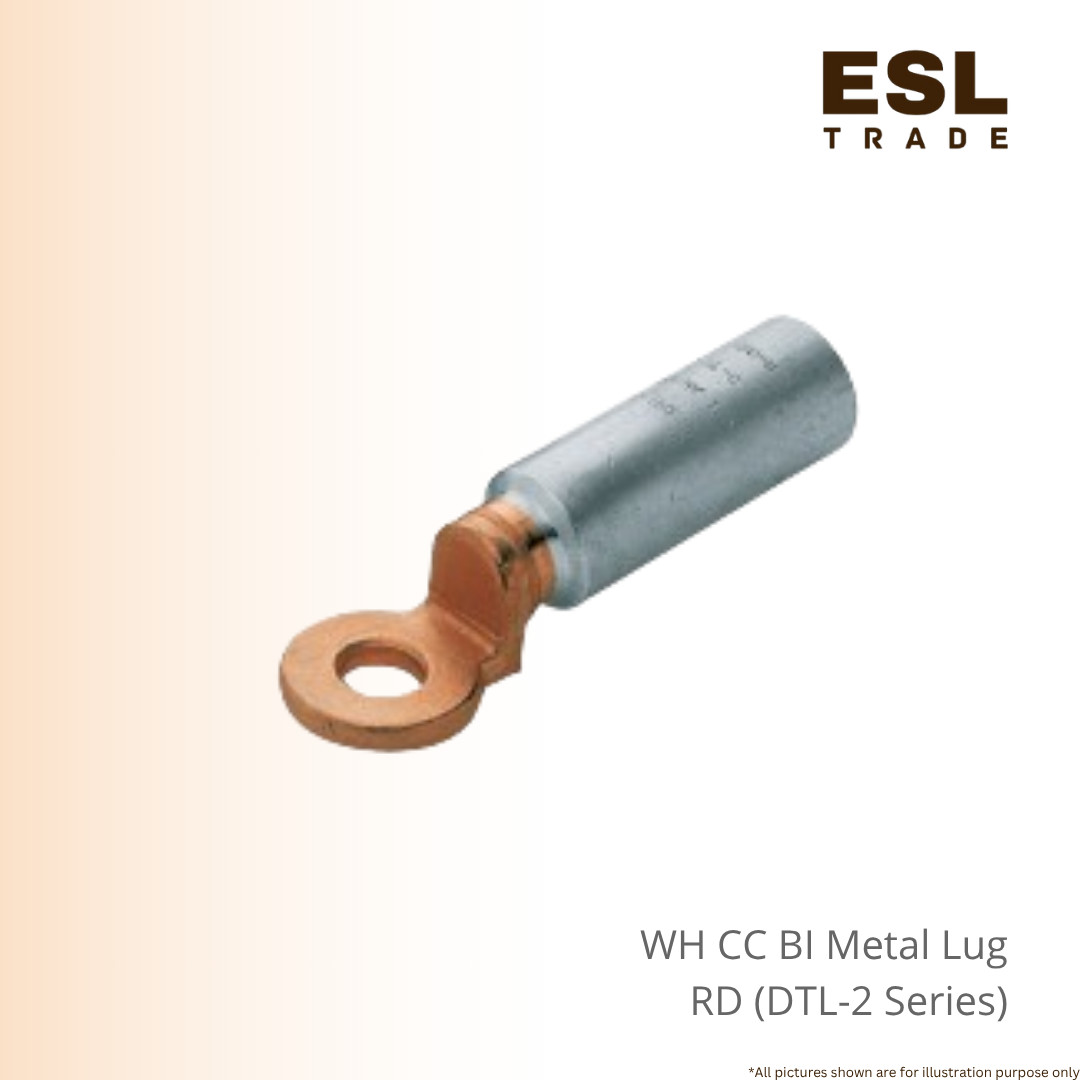
WIN CC Bi-Metal Lug (RD) Round Palm Type Friction Welded Cable Terminal (16mm² to 630mm²) Copper-Aluminum Connector High Reliability Transition
The CC Bi-Metal Lug (RD) Round Palm Series (DTL-2) provides a seamless transition interface for connecting aluminum cables directly to copper equipment terminals, switchgear, and busbars.
Connecting aluminum conductors directly to copper contact points often triggers galvanic corrosion, contact degradation, and localized heating due to dissimilar electrochemical potentials.
The DTL-2 series addresses this issue by permanently joining an electrical-grade aluminum barrel to a solid copper round palm using precision friction-welding technology.
Designed with a round (RD) palm profile, these lugs offer maximum surface contact area and uniform mechanical clamping force across standard busbar studs and switchboard posts.
The solid copper round palm bolts directly onto copper busbars, while the aluminum barrel accepts stripped aluminum conductors for crimp termination without risk of galvanic degradation.
The CC-DTL-2 round palm series supports conductor sizes ranging from 16mm² up to 630mm² across standard stud hole sizes:
-
Light to Intermediate Sizes (16mm² to 35mm² / Ø 11 mm Hole): Feature 40mm barrel lengths and Ø 20mm round palm diameters for compact power distribution feeds.
-
Medium-Duty Cable Sizes (50mm² to 95mm² / Ø 13 mm Hole): Incorporate $43\text{ mm}$ barrel lengths and $\Phi 25\text{ mm}$ round palm diameters for commercial panels and sub-main distributions.
-
Heavy Power Feeder Sizes (120mm² to 300mm² /Ø 13 mm Hole): Engineered with barrel lengths up to 65mm and palm diameters up to Ø 35 mm for primary switchboard connections.
-
Extra-Heavy Industrial Sizes (400mm² to 630mm²/ Ø17 mm Hole): Built for high-amperage utility infrastructure, accommodating conductor inner diameters up to Ø33.5mm and barrel outer diameters up to Ø 47 mm.
Product Detail
| Type A (mm) | P±0.3 | D±0.5 | d±0.3 | L±3 | L1±0.3 | W±0.5 | S±0.3 |
| DTL-2-16-11 | Φ11 | Φ16 | Φ6 | 80 | 40 | Φ20 | 3 |
| DTL-2-25-11 | Φ11 | Φ16 | Φ7 | 80 | 40 | Φ20 | 3 |
| DTL-2-35-11 | Φ11 | Φ16 | Φ8.5 | 80 | 40 | Φ20 | 3 |
| DTL-2-50-13 | Φ13 | Φ20 | Φ10 | 90 | 43 | Φ25 | 4.5 |
| DTL-2-70-13 | Φ13 | Φ20 | Φ11.5 | 90 | 43 | Φ25 | 4.5 |
| DTL-2-95-13 | Φ13 | Φ20 | Φ13.5 | 90 | 43 | Φ25 | 4.5 |
| DTL-2-120-13 | Φ13 | Φ25 | Φ15 | 115 | 59 | Φ30 | 5.5 |
| DTL-2-150-13 | Φ13 | Φ25 | Φ16.5 | 115 | 59 | Φ30 | 5.5 |
| DTL-2-185-13 | Φ13 | Φ32 | Φ18.5 | 122 | 60 | Φ35 | 6 |
| DTL-2-240-13 | Φ13 | Φ32 | Φ21 | 122 | 60 | Φ35 | 6 |
| DTL-2-300-13 | Φ13 | Φ34 | Φ23.5 | 128 | 65 | Φ35 | 6 |
| DTL-2-400-17 | Φ17 | Φ40 | Φ28 | 160 | 90 | Φ36 | 6 |
| DTL-2-500-17 | Φ17 | Φ40 | Φ30 | 160 | 102 | Φ36 | 6 |
| DTL-2-630-17 | Φ17 | Φ47 | Φ33.5 | 186 | 95 | 45 | 8.5 |
Tolerances: P ± 0.3mm, D ± 0.5mm, d ± 0.3mm, L ± 3 mm, L1± 0.3mm, W±0.5mm, S ± 0.3mm.
Frequently Asked Questions (FAQ)
Q1: What is the main difference between the RD (Round Palm) and SQ (Square Palm) bimetal lugs?
A : The RD (Round Palm) features a circular contact head that offers a broad, circular contact surface ideal for standard flat busbars, transformer pads, and switchboard terminals.
The SQ (Square Palm) has a narrower straight-sided shape designed to fit inside the tight phase barriers of Molded Case Circuit Breakers (MCCBs).
Q2: How do I read the order code for the DTL-2 series?
A : The code indicates the model, wire size, and bolt hole size. For example, DTL-2-120-13 signifies a DTL-2 model designed for a 120mm² conductor with a Ø 13 mm hole size (suitable for M12 terminal bolts).
Q3: Can a copper cable be crimped into the aluminum barrel of a DTL-2 lug?
A : No. The barrel is made of electrical-grade aluminum and sized specifically for aluminum stranded conductors.
Inserting a copper wire into an aluminum barrel can cause galvanic corrosion within the barrel. Copper cables should be terminated using standard tinned-copper lugs.
Q4: Why is friction welding used to join the copper palm and aluminum barrel?
A : Friction welding creates a solid-state metallurgical bond between copper and aluminum without melting the metals.
This eliminates air voids, minimizes electrical resistance, and prevents galvanic degradation at the joint interface.
Q5: Should jointing compound be applied inside the barrel during installation?
A : Yes. Applying contact grease or anti-oxidation paste inside the aluminum barrel before inserting the wire removes the aluminum oxide layer and prevents moisture and oxygen ingress, ensuring low electrical contact resistance over time.
Reviews
There are no reviews yet.